
HISTORY OF THE DEPARTMENT
Government Mohan Kumaramangalam Medical College was started in 1986. The foundation stone was laid by late Sri Rajiv Gandhi, the Prime Minister, in 1987, and MCI recognition was received in 1996.
Our first ophthalmic ward was opened by Sri K. Kamaraj Nadar, Chief Minister, on 20‑10‑1956. Our hospital is the tertiary care centre for the surrounding 4 districts.
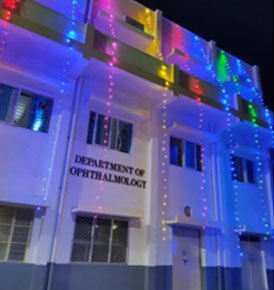
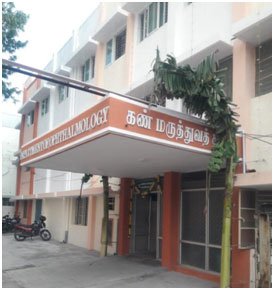
The Ophthalmology department functions in a separate block accommodating the outpatient, inpatient and operation theatres, with 4 major operation theatres and one minor operation theatre. We see around 35,000 outpatients per year and operate on more than 4,000 patients per year.
We have trained faculty for Cornea, Oculoplasty, Vitreoretinal surgery, low vision aids, Strabismus, Paediatric Ophthalmology and Medical Retina, performing surgeries all 6 days a week — including Cataract (SICS / Phacoemulsification), Keratoplasty, Oculoplasty, anti-glaucoma surgeries, squint surgery, and surgeries for paediatric cataract and retina.
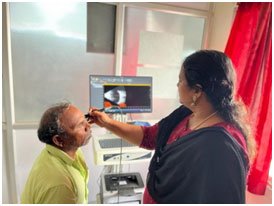
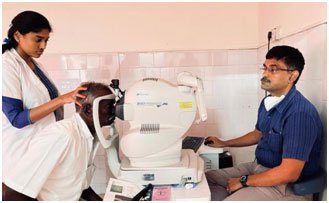
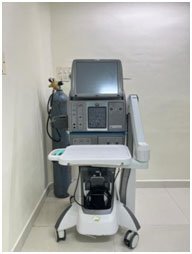
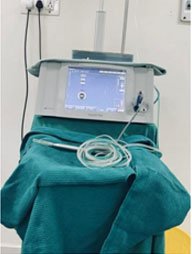
Special clinics are run for Glaucoma and Nd:YAG laser (iridotomy and capsulotomy). We screen for Retinopathy of Prematurity in NICU infants and diabetic retinopathy in the diabetic outpatient department, with a complete Vitreoretina set-up including OCT, fundus camera, B-scan, green laser and a dedicated vitreoretina operation theatre. Green laser is also used to treat retinal diseases (ROP and DR). Being a tertiary care centre with a super-speciality hospital, we attend to a large number of trauma and neuro-ophthalmology patients. 2 seats of MS postgraduates have joined the department each year since 2017.
OUR DEPARTMENT PAST HOD
ADMIN
Name & Designation of Faculties
| S.No | Designation | Name of the Faculty |
|---|---|---|
| 1 | Professor & HOD | Prof. Dr. A. R. Anbarasi, MBBS, DO, MS (Ophthal) |
| 2 | Professor | Dr. P. Venkatesh, MBBS, MS (Ophthal) |
| 3 | Associate Professors | Dr. R. Thenmozhi, MBBS, MS (Ophthal); Dr. R. Niraimozhi, MBBS, MS (Ophthal) |
| 4 | Assistant Professors | Dr. S. Uma Maheswari, MBBS, MS (Ophthal); Dr. P. V. Rajendran, MBBS, MS (Ophthal) |
| 5 | Senior Resident | Dr. R. Sathiskumar, MBBS, MS (Ophthal) |
Address for Communication
Department of Ophthalmology, Government Mohan Kumaramangalam Medical College Hospital, Salem – 636001
Department Email
govtophthal@gmail.com
Website In-charge
Dr. R. Thenmozhi, MS (Ophthal)
ACADEMIC ACTIVITIES
Courses Handled
Training Given to Undergraduate Students
- 8 weeks of clinical posting and 100 hours of theory classes handled by department faculty for pre-final year MBBS students
- Students are taught to examine patients, make clinical diagnoses and present cases
- Students observe surgeries in the operation theatre
- Group discussion every Friday
- 4 symposia conducted for pre-final year students
SPECIAL ACADEMIC:
CME and quiz programmes for undergraduates.
CRRI
All undergraduate students undergo training in Ophthalmology during their internship for 15 days, with a weekly group clinical discussion on interesting cases.
Nursing Students
Diploma and B.Sc. Nursing students attend the eye OP for clinical posting, with theory classes also taken by department faculty on Tuesdays and Fridays.
Library
A spacious and furnished library with books and journals is available in the department.
RESEARCH PUBLICATION BY FACULTIES:
Dr. P. Venkatesh
An analytical study on the role of focal lasers in the treatment of chronic central serous chorioretinopathy in a tertiary care centre — International Journal of Scientific Research, March 2019
Study of incidence and risk factors of Retinopathy of Prematurity in a sick neonatal care unit in a tertiary care centre — Global Journal of Research Analysis, March 2019
A study on changes in choroidal thickness in antenatal women with pregnancy-induced hypertension using spectral domain optical coherence tomography — December 2020
Dr. R. Thenmozhi
Incidence of ocular and systemic associations with congenital ptosis, its management and complications following ptosis surgery — Original Article, JEMDS, Vol. 5, Issue 6, Jan 2016
Sodium bicarbonate buffered lignocaine and hyaluronidase-mixed lignocaine for ocular anaesthesia in cataract surgery — a comparative study — International Journal of Science
A study on changes in choroidal thickness in antenatal women with pregnancy-induced hypertension using spectral domain optical coherence tomography — Kerala Journal of Ophthalmology, December 2020
Dr. S. Umamaheswari
To determine the association of glaucoma in pseudoexfoliation — Journal of Evidence Based Medicine and Health Care, October 2018
Incidence of retinopathy changes in newly detected cases of Type 2 diabetes mellitus — Journal of Evidence Based Medicine and Health Care, April 2018
CME
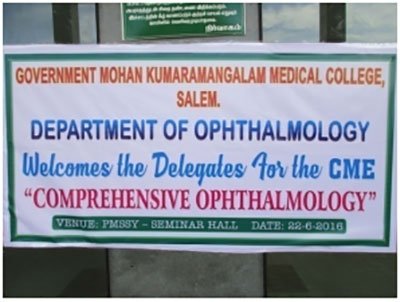
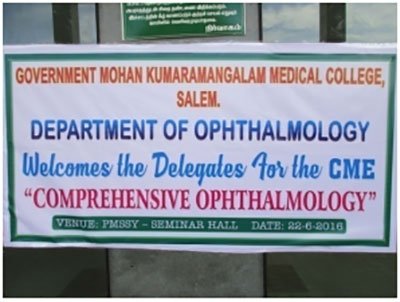
Departmental CME — Comprehensive Ophthalmology, 22‑06‑2016, Conference Hall, PMSSY Auditorium, with 10 credit points.
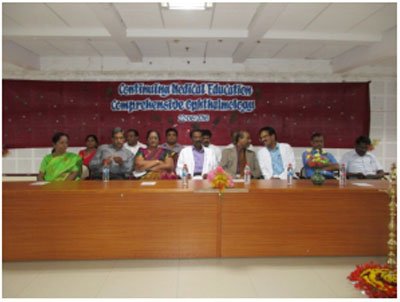
Hands-on training in fundus examination was conducted for postgraduates in Medicine, Paediatrics and Psychiatry departments.
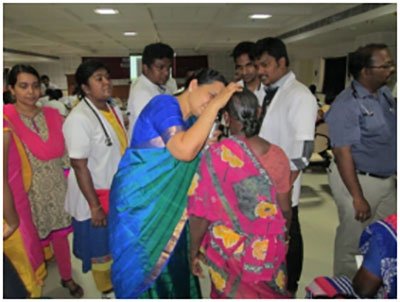
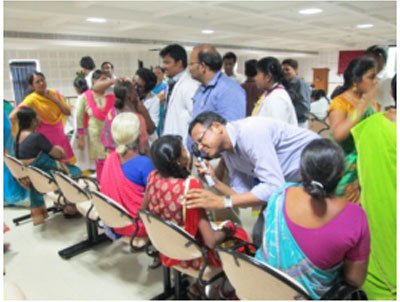
Another CME, regarding ROP, was conducted in October 2018.
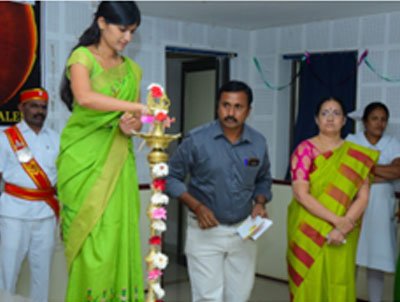
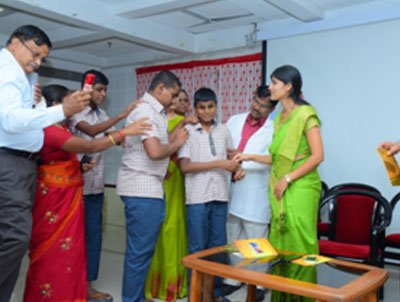
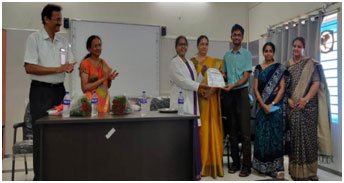
A quiz programme was conducted for undergraduate students; after the final round, the first three prizes were distributed — 1st prize: Titan watch with mementos; 2nd prize: pen drive with mementos; 3rd prize: mementos.
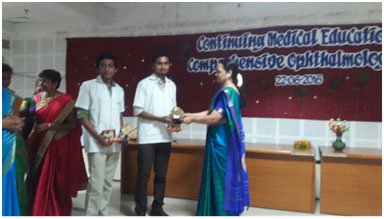
The Rishi Nethralaya Medal Examination for Final Year MBBS Part‑1 was held on 09‑03‑2020 for the year 2019–2020; Dr. Soorya won the medal.
INFRASTRUCTURE:
- 2-floor building with individual faculty rooms
- Beds — 40
- Major OT — 4
- Minor OT — 1
- Auditorium with smart board
- Library
- Separate speciality clinic rooms
- Eye banking
PERFORMANCES
| S.No | Performance | Year I (2020) | Year II (2021) | Year III (2022) |
|---|---|---|---|---|
| 1 | No. of patients in OPD | 39662 | 18955 | 25467 |
| 2 | No. of patients in IPD | 3697 | 1208 | 3303 |
| 3 | No. of major operations | 3562 | 1161 | 2585 |
| 4 | No. of minor operations | 1585 | 217 | 504 |
| 5 | No. of day-care operations | 4700 | 1600 | 3017 |
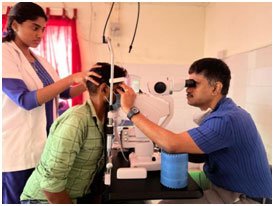
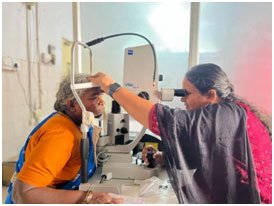
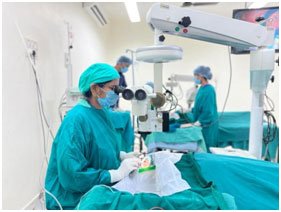
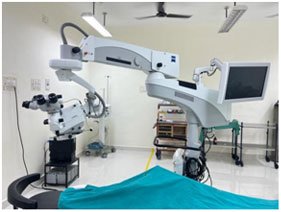
INFRASTRUCTURE & EQUIPMENTS & FACILITIES AVAILABLE:
SPECIALITY CLINICS
| S.No | Speciality Clinic | Day |
|---|---|---|
| 1 | Glaucoma Clinic | Wednesday |
| 2 | Squint Clinic | Saturday |
| 3 | Cornea | Tuesday |
| 4 | Retina Clinic | Thursday & Friday |
| 5 | Neuro-Ophthalmology Clinic | Saturday |
| 6 | Oculoplasty Clinic | Monday |
CMCHIS
A number of patients have benefitted under CMCHIS. Surgeries performed under this scheme include:
- Congenital cataract
- Trabeculectomy for glaucoma
- Lid reconstruction for tumours, eyelid defects and trauma
- Keratoplasty
- Evisceration / enucleation with orbital implants
- Green lasers for diabetic retinopathy
- Orbitotomy
- Strabismus surgery — 2-muscle / 3-muscle
- Inj. methylprednisolone for optic neuritis
- Ptosis surgery
- Vitrectomy
- Intravitreal injections
- Pterygium
- Lateral canthoplasty
- Tarsorrhaphy
- Corneal / scleral tear repair
- PRP
- YAG capsulotomy / iridotomy
EYE DONATION
WHOM CAN DONATE EYE?
- Anyone from the age of one, There is no age-limit for donating the eye.
- People using spectacles and those diagnosed with diabetes and hypertension can donate their eyes.
WHOM SHOULD WE CONTACT TO DONATE EYES?
- Eyes need to be removed within six hours after death
- So it is important to get in touch with your nearest eye bank at the earliest.
PLEASE REMEMBER THE FOLLOWING:
- Keep the eyes of the deceased closed and covered with moist cotton.
- Switch off the ceiling fan, if any, directly over the deceased person
- If possible, apply antibiotic eye drops periodically in the deceased’s eyes to reduce the chance of any infection.
- Raise the head of the deceased by about six inches, if possible, to reduce the chances of bleeding at the time of removal of the eyes
WHO CANNOT DONATE THEIR EYES?
- Death due to unknown causes.
- People who die due to infections such as rabies, syphilis, infectious hepatitis, septicemia, and AIDS, cannot donate.
Who should we contact to donate eyes?
Eyes need to be removed within six hours after death, so it is important to get in touch with the nearest eye bank at the earliest.
CAN A PERSON WHO IS BLIND DUE TO RETINAL OR OPTIC NERVE DISEASE DONATE HIS EYES?
Yes, provided the cornea of the donor is clear.
Emergencies, more details & pledging your eyes
Contact: 0427–2210674, GMKMC Hospital, Salem.